Translate

Thursday, August 15, 2013

FMCSA Shuts Down Florida-based McRea


FMCSA Shuts Down Florida-based McRea Transportation, Inc.

WASHINGTON - The U.S. Department of Transportation's Federal Motor Carrier Safety Administration (FMCSA) today announced that Hialeah, Fla.-based McRea Transportation, Inc. (USDOT No. 1838244), one of two unrelated bus companies that had stranded New York City-bound passengers in Virginia following a mechanical breakdown last month, has been declared an imminent hazard to public safety and ordered to cease all operations. The company was served the federal orders July 24, 2013.
“There is no place on our highways and roads for bus operators who disregard safety,” said U.S. Transportation Secretary Anthony Foxx. “Passengers should be able to trust that the company they use will be able to get them to their destination in a safe and timely manner.”

McRea Transportation operated a small fleet of motorcoaches and had recently conducted passenger services for a tour provider between Atlanta and New York City.

On July 11, 2013, a McRea Transportation motorcoach broke-down in Northampton County, N.C., along Interstate 85 at 2:30 a.m. Fifty passengers were later transported to a Virginia welcome center by state law enforcement officers where they waited approximately 10 hours for a replacement motorcoach to arrive.

On July 15, 2013, FMCSA safety investigators launched an investigation of McRea Transportation and found that the company owners failed to monitor and ensure that its drivers complied with federal hours-of-service requirements and controlled substances and alcohol use testing regulations. Drivers’ duty status records books were also falsified in an attempt to operate a 50-passenger motorcoach on a trip from New York City to Atlanta.

Investigators also found that McRea Transportation had failed to repair vehicle deficiencies thereby posing an ongoing and imminent hazard to the public. A copy of the McRea Imminent Hazard Out-of-Service Order can be viewed at www.fmcsa.dot.gov/documents/about/news/2013/McReaTransportationInc.pdf


“Safety is our highest priority and we charge every bus or trucking company to make it their number-one priority as well,” said FMCSA Administrator Anne S. Ferro. “Every driver and every passenger deserves to reach their destination safely. Companies that needlessly place the traveling public at risk will be shut down.”
This action becomes the 17th out-of-service order issued by FMCSA since the deployment in April 2013 of more than 50 "Operation Quick Strike" safety investigators targeting high-risk passenger carriers.


In the past three months, FMCSA has also revoked the operating authority of ten additional bus companies following compliance review investigations that resulted in an “unsatisfactory” safety rating.


Since the beginning of 2013, FMCSA has issued out-of-service orders to a total of 24 bus companies and nine trucking companies. The agency has also declared seven commercial driver's license holders as imminent hazards, blocking them from operating in interstate commerce.

As part of FMCSA's work to make safety data readily available to the traveling public, the SaferBus mobile app gives bus riders a quick and free way to review a bus company's safety record before buying a ticket or booking group travel. The SaferBus app, available for iPhone, iPad and Android phone users, can be downloaded for free by visiting FMCSA's “Look Before You Book” webpage at www.fmcsa.dot.gov/saferbus.
Travelers planning a bus trip are also encouraged to think safety first before buying a ticket or chartering a bus by using FMCSA's multilingual passenger carrier safety checklist at: http://www.fmcsa.dot.gov/safety-security/pcs/Index.aspx.
FMCSA urges consumers and whistleblowers to report any unsafe bus company, vehicle or driver to the agency through a toll free hotline 1-888-DOT-SAFT (1-888-368-7238) or FMCSA's consumer complaint web site: http://nccdb.fmcsa.dot.gov/HomePage.asp.
Consumers who bought a ticket on a bus company that FMCSA has recently placed out-of-service may be entitled to a credit from their credit card company under the Fair Credit Billing Act if they paid for the ticket by credit card. For more information visit: http://www.fmcsa.dot.gov/safety-security/pcs/bus-credit-refund.aspx.

Tuesday, August 13, 2013

Appeals Court Upholds Most of HOS Rules

A federal appeals court has upheld most new hours of service rules for truck drivers


WASHINGTON — A U.S. appeals court on Friday upheld the majority of new federal hours of service rules, but rejected a 30-minute rest requirement for short-haul drivers, potentially ending a vicious and drawn-out battle between the trucking industry and regulators.


The new rules, which took effect on July 1, require truck drivers to take a 30-minute break after working eight consecutive hours and limit the use of a 34-hour restart provision designed to get drivers back on the road more quickly after completing a week’s work. The Federal Motor Carrier Safety Administration rules are expected to tighten truck capacity, resulting in higher costs for shippers.


The U.S. Court of Appeals for the District of Columbia Circuit decision responds to two challenges. The ATA challenged the rules in federal court, arguing a change in truck driver hours of service was unwarranted based on recent improvements in truck safety and wasn't supported by scientific data. The Advocates for Highway and Auto Safety, Public Citizen, and the Truck Safety Coalition also challenged the rules, arguing they didn't go far enough to ensure truck safety.


Complete coverage of trucking hours of service
“It is often said the third time’s a charm,” Judge Janice Rogers Brown wrote. “That may well be true in this case, the third of its kind to be considered by the Circuit. With one small exception, our decision today brings to an end much of the permanent warfare surrounding the HOS rules. Though FMCSA won the day not on the strengths of its rulemaking prowess, but through an artless war of attrition, the controversies of this round are ended.”


But evidence suggests the hours of service debate is far from over.
The FMCSA estimates the new work rules will prevent 1,400 crashes, 560 injuries and 19 deaths a year, with an estimated $280 million in savings from fewer large truck crashes and $470 million in savings from reduced fatigue and improved truck driver health.

Diesel Fuel Declines Second Straight Week


Diesel dipped 0.6 cent to $3.909 a gallon, the first downturn following four increases, while gasoline dropped for a second straight week, the Department of Energy reported.


Gas fell 1.4 cents to $3.632 a gallon, DOE said late Monday following its weekly survey of filling stations.


Diesel had gained nearly a dime in the previous four weeks, while gasoline fell more than 19 cents in the two weeks prior to this week and last week, in which it fell a nickel.


Despite the slide, Monday’s diesel price is 5.9 cents above the same week last year. Gas is 1.3 cents less than the same week last year.
Oil fell 38 cents Monday but held over $106 a barrel on the New York Mercantile Exchange, Bloomberg News reported. Crude futures slipped to $106.56 a barrel on the Nymex.


Each week, DOE surveys about 400 diesel filling stations and 800 gasoline stations to compile national average prices.

Sunday, August 11, 2013

Advoiding... " The Right Turn Squeeze "


Right turns are a frequent problem for trucks. Accidents can occur when other vehicles squeeze into the area along the right side of
your vehicle. The other vehicle may beat tempting to pass on the right or make a right turn. While the other vehicle may be at fault, defensive drivers must anticipate the errors of other drivers.

 Recognize that automobile drivers are constantly looking for ways to get around your truck. Assume they will make mistakes.

What is right turn squeeze?


Collisions with a vehicle attempting to pass on your right side
while you are attempting a right turn maneuver.Why is this a problem to be concerned about According to many insurance carriers, in over 90% of right turn squeeze situations either the
truck driver is cited for unsafe turning or without a citation
issued the trucking company still must pay for the damage to
the other vehicle.


What causes the problem?

Setting up wide or swinging too wide when making a right turn?
Failure to signal turn?

Other motorists not recognizing turn signals or setup for right turns of trucks?

Other motorists in too big of a hurry to pass the truck?  How can it be prevented?

Anticipate the turn. Set up for the turn, blocking the right side of your vehicle,so that cars cannot enter that area.

Check behind you. Monitor your mirrors as you approach your turn, so that you know what traffic is behind you.

Get in the proper lane as quickly and safely as you can before you turn. Atleast 10 feet before the turn. It is important to establish your position.

Use your turn signal and slow down. Communicate your intent to turn.

Keep the rear of the vehicle close enough to the right curb to keep vehicles out. Don’t allow the option to cut inside you, block the curb with your rear tires.

Stay within four feet of the curb, but avoid scraping or climbing the curb. Check your right mirror prior to and during your turn to make sure there are no small vehicles in the way. Wide shoulders and parking lanes may provide an opportunity for automobiles to sneak in. Beware of Sharp right turns around poles or into narrow drives that may cause you to swing wider than normal and give up your lane.

Make your turn slowly. Travel at a speed that allows you to monitor your mirrors and stop, if necessary.


Make your turn without crossing the center line of the street you are leaving and, if possible, not into the opposing traffic lanes of the road you are entering.


Where are some specific areas that may open up the possibility
of accidents with right hand squeeze?

Wide streets or streets with wide shoulders where cars try to cheat to get around us ?

Sharp right turns (possibly around poles when we have to cheat to the left prior to making the hard right turn) ?

Bike paths ?


Question for discussion -
1) Are there particular locations in our service area that present right turn squeeze hazards?
2) Where will our next accident occur?
Right turn squeeze or otherwise?
3) How can it be prevented?

Thursday, August 8, 2013

The Celebrity Coach of America Experience


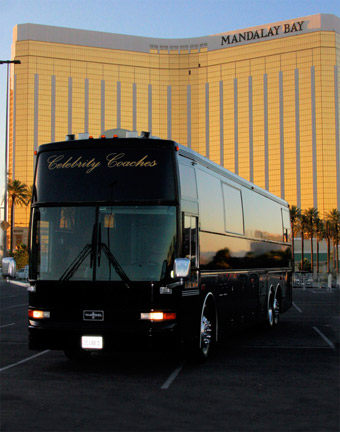
The Celebrity Coach experience begins when the Van Hool arrives at the door.

  When she set out to establish her own motorcoach operations in 2003, Paulina Salen, president and CEO, Celebrity Coaches of America, Las Vegas, NV, was not about to settle for anything less than the Wow! Factor.


  She envisioned a small to mid-size company of no more than 25 vehicles that would combine limousine and luxury coach service. Salen and her team would deliver customer service to the Nth degree for both the business community and the party crowd in a town marked by its penchant to pamper and indulge. Seven years later: mission accomplished.


  The proverbial bus bug bit Salen during her college years in Vancouver, BC, Canada, where she worked in dispatch for a motorcoach company. She later relocated to Las Vegas, and spent five years with Nevada Charter, where she moved from dispatch to general manager before the company sold to Coach USA in 2000. 

  During that time she saw Nevada Charter grow from four coaches to 62 at the time of the sale. Salen stayed on as sales director under the new owners for two years before leaving to eventually form her own do-it-all transportation company.


  Salen, a staff of nine and 38 drivers provide group charters, corporate and sports team transportation, airport transfers, shuttles for conventions and tradeshows, party coaches for weddings, reunions, specialized tours, sightseeing and school field trips.

  A fleet of 22 Van Hool luxury motorcoaches serves the two divisions of the company. The motorcoach division provides the basic services, while the limousine coach division specializes in customized transportation experiences. Eleven coaches with standard seating configurations handle the basic coach charters and transport. 

  The other eleven party buses feature custom interiors that Salen has individually designed to satisfy a wide array of customer preferences. Two M1235s from ABC Companies also outfitted in custom décor serve as executive limousine coaches for smaller corporate groups.


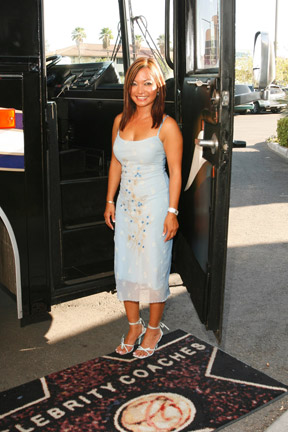
Celebrity Coaches founder and CEO Paulina Salen is hands on in customer service.

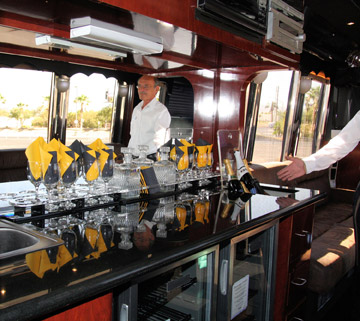
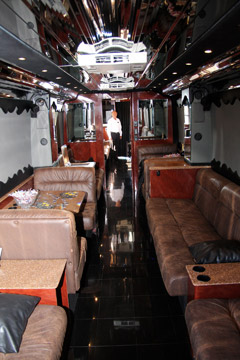
  The themes range from reserved and subdued appointments to flamboyant leopard and zebra upholstery. The party coaches and limos feature bars, flatscreen TVs, elaborate sound systems and electronics, as well as fiber optics.

  “Celebrity Coaches is a very manageable niche that allows us to pay closer attention the details, which makes us who we are,” says Salen. “We never want to be any bigger than we are now. Our customers know us as the company that can personalize everything.”

  The Nevada Minority Business Council named Celebrity Coaches best in professional service in 2006 and nominated the company again this year.

  “Our largest segment of business is with business groups that prefer the privacy, flexibility and amenities enjoyed in the executive limousine coaches,” says Stacie Lu, vice president, sales and operations. “But this is Las Vegas and everyone comes ready to have fun, and our coaches and operations certainly cater to their high expectations.”

  Lu says corporate groups can conduct meetings and presentations on board. With advance notice and some pre-planning, Celebrity Coaches can have power point and visuals ready when they board.

  Salen says with the size of Celebrity Coaches firmly established as midsize only, she has been able to concentrate on her customer service priorities and her plan to build the company headquarters and maintenance facility. Taking advantage of the depressed market in Las Vegas, Salen purchased the land in 2006 and began construction on the permanent facility two years later. It opened in November 2009 complete with administrative offices and a three-bay maintenance shop.


Eleven party buses feature custom interiors that satisfy a wide array of customer preferences.

  Now situated less than a mile from McCarron International Airport, Lu says Celebrity Coaches is positioned to make transition from air to ground fast and seamless — even with those unpredictable blind arrivals.

  “We make every effort to get all the pertinent travel information up front so we can greet our customers on time and guide them as effortlessly as possible,” she says. “But we always have to be ready to think on our feet.” 

  Salen says even the more difficult customers who may not plan as carefully expect and do receive the same high level service.
“We work with it,” she says. “I believe this is largely why our business has survived and grown.”

  The company philosophy carries into every department and every employee. Salen says all Celebrity Coach drivers receive cross training on each of the vehicles, as everyone is a little different. They also learn to quickly read the varying mix of customers. 

  She says for them to know when to remain subdued and less engaged for the corporate clients conducting business on board is as important as keeping it lively for revelers out on the town.


Paulina Salen personally designs and appoints the coach interiors.

  “Some customers want all the information, every detail about Las Vegas, we can throw at them,” say Salen. “Others just want to be left alone. We have become very adept at knowing when to turn it on when to back it off.”

Either way, says Salen, the mission is to wow the customer.

Friday, August 2, 2013

Analysis Show The Fiscal Benefits of Buses


Deron Lovaas Posted August 1, 2013 

As I’ve written (here, here and here, for starters) it’s high time buses received more attention and investment in this country. Everyone loves to talk about other modes – especially bikes and trains – as the sine qua non for energy-efficient, livable and sustainable communities. 

Meanwhile, year in and year out, ridership on buses eclipses other non-auto modes. They are oft-maligned workhorses of the transportation system. Thankfully, within cities there’s a sizzling new entry in the bus marketplace – bus rapid transit. As friends noted a few years ago in a report, these lines are cropping up across the country as signs of transit innovation. Launched originally in Curitiba, Brazil decades ago by a visionary mayor (don’t cities usually lead the way?), this means of bus travel is spreading around the world as well as across the U.S. In fact, there’s even an effort afoot to standardize and grade “bus rapid transit” projects to make sure they live up to the name so the brand won’t get tarnished over time. Now is the time to turn our attention to bus routes between cities. 

Right now more than 16,000 buses ply our roads, connecting nearly 2,800 cities and towns. This week friends at Taxpayers for Common Sense, the Reason Foundation and the American Bus Association Foundation released an analysis by respected consulting firm MJ Bradley and Associates, comparing bus to Amtrak service linking 20 city pairs. One of the performance metrics examined is air pollution, and buses shine here (although, to be clear, both modes shine when compared to driving alone). 


The graph below illustrates this for heat-trapping carbon dioxide pollution: Busgraph1.jpg While this may seem surprising considering the bad rap buses get vis-à-vis tailpipe emissions, it makes sense when you think about it. First of all, trains pollute too, although you (like me) probably suffer from “availability bias,” meaning that images readily spring to mind of being stuck in traffic behind a bus annoyingly spewing pollution while none of us gets trapped behind a train. But buses are getting cleaner, and trains aren’t pollution-free (the analysts note that the electrified Northeast Corridor is cleanest). And more importantly, these vehicles are only as clean on a per-passenger basis as their load factor determines. 


A fully loaded vehicle looks good compared to an emptier one, per-passenger, as you can see from this graph from a report I co-wrote a few years ago (pdf of whole report here): 


What about costs? 
Again, buses compare well. First the analysts examined fares charged, finding that while they vary they are usually comparable on these routes. However, the cost differential between them is huge, as you can see from the graph below. Busgraph2.jpg How is the gap filled? If you guessed government subsidies, you are right. 

The graph below shows just how large they are, with two exceptions: The Boston-NYC and Washington, DC-Lynchburg, VA stretches of eastern corridor service. These latter routes actually make enough revenue to more than pay for themselves. The analysts note that a few other routes pay for their operating costs, but fall short when capital costs are included. Busgraph3.jpg To wrap this glimpse of this study up, 


I want to make clear that I am not saying we should rob Peter to pay Paul. We need more, and upgraded, rail service connecting our cities. However, we also need real competition if consumers are to benefit (this is the whole point of a little coalition we formed with the American Bus Association, among others, called Mobility Choice). 

Consumers deserve multiple options for traveling between cities. That means that we need more, and upgraded bus service as well. I used to travel regularly on C & J buses in the northeast and can testify that it can be cost-effective and comfortable already, so there's a solid foundation for expansion and improvement. But all too often buses get a bad rap, and not enough attention in national, state and metropolitan policy. That needs to change, given the data presented in this report, and in the wake of the BRT revolution underway. 

Let’s get to work on delivering more rubber-tired transit service linking cities, by giving buses a seat at the table when making transportation investment plans and programs.

Thursday, August 1, 2013

Wickman Opened a Hupmobile Dealership


In 1914, a laid-off miner named Carl Wickman opened a Hupmobile dealership in Hibbing, Minn.

When he couldn't make a sale in the Iron Range village, he turned the seven-seat Hup into a bus, ferrying his former workmates between the mines and their homes.
From this humble start, Wickman created Greyhound Corp., the iconic bus firm that opened up America's highways to the masses.


Wickman moved from Sweden to Arizona to Minnesota, where his bus firm became king of the road. Greyhound
Wickman moved from Sweden to Arizona to Minnesota, where his bus firm became king of the road. 
A Swedish immigrant with an eye for profit, Wickman (1887-1954) battled terrible roads, blizzards and mechanical breakdowns in the early years. During the Great Depression he nearly went bankrupt.
But over the long haul, Wickman steered his company toward fame and profit, parlaying a two-mile route into one of the leading bus transport services in the country.
"He was a jovial man,'' Carlton Jackson, author of "Hounds of the Road: A History of the Greyhound Bus Company," told IBD. "But he was determined. Minnesota was a rough place to start anything that had to do with transportation. He had to overcome a lot of obstacles."


Westward

Wickman was born in a village near Mora, Sweden. At the urging of a friend, he left the Scandinavian country in 1905 to travel to Arizona. Just a teen, he used all his money for a train ticket from New York to Tucson, only to find that his friend had left town.

Wickman's Keys

  • The Swedish immigrant started a bus firm in Hibbing, Minn., in 1914 and made it Greyhound Corp., the transportation giant.
  • Overcame: Freezing weather, terrible roads, the Great Depression.
  • Lesson: Drive and hard work never go out of style.
  • "He had the guts to take chances," said Gene Nicolelli, director of the Greyhound Bus Museum in Hibbing.
  •  
  •  
Although he was broke, couldn't speak English and didn't know a soul, he managed to get a job at a sawmill.
"However, the Arizona sun was a little different from the Swedish sun," Jackson said. "Meanwhile, he heard from a few of his friends who had gone directly to Minnesota that the climate up there was more like Sweden."

After saving enough money for the train fare, Wickman headed north to Hibbing, a rugged mining town with a pioneer flavor.
After working in the mines for years as a diamond-drill operator, he was laid off in 1913.

He was 26 and refused to sit still. He bought the Hupmobile dealership — and when he couldn't sell the seven-seat car, the precursor to the SUV, he began shuttling miners to work and back.
The bus was an immediate hit, with miners squeezing in any way they could. They sat on each other, stood on the running boards and clung to the back bumpers.

Wickman charged 15 cents for a one-way trip and a quarter — worth $6 now — for the round trip. With gasoline selling for 4 cents a gallon, he made money.

That was the upside.


The downside? The conditions.

His early drivers battled unpaved roads and Minnesota's freeze to deliver their passengers on time. Flapping curtains did little to keep out the snow. Blizzards made driving perilous, and a flat tire could result in miserable delay. "In one instance the snow was so deep that four men got out and walked," Jackson said. "They said it was quicker.


Greyhound rolled in the 1920s, becoming the transportation of choice for vacationers, salesmen, even jazz bands. Dismuke.org

Greyhound rolled in the1920s, becoming the transportation of choice for vacationers, salesmen, even jazz bands.  

"It was something like the Wild West. In the beginning it was called the Snoose Line. Snoose in Swedish means snuff. The person who wanted a ride would take out his snuffbox and show it to the driver as he approached, and the driver would know the man on the street wanted a ride. Of course it was a little precarious to stay in the line of fire 'cause there were a lot of people spitting, and if you weren't careful you'd get a face full of snuff."


After that first winter, Wickman had enough of the drudgery. So he sold his interest in the company.
But when the firm's men asked him back, offering to reduce his driving duties, he jumped back in.
In 1915, their first full year, Wickman and his remaining partner, Andy Anderson, started 15-mile runs to Nashwauk, Minn., creating the country's first regular intercity bus route.
Their operation was on a roll. Demand was so high, they added cars. When those vehicles weren't enough, Wickman and Anderson stretched each car — cutting the frame in half, welding new pieces to the body, adding seats to accommodate 12 miners.


Growing
Wickman bought out competitors — and in 1916 formed Mesaba Transportation Co.
Two years later the company had 18 cars and an annual income of $40,000, or $600,000 today.
Wickman now lengthened his aim: to carry passengers anywhere in the country on one ticket.
At the end of World War I in November 1918 he sold his share of the business for $60,000 (worth $900,000 today), moved to Duluth, Minn., and started gobbling up his one-car competitors.
He made a crucial move in 1925, buying a small line operating out of Superior, Wis., that was owned by Orville Caesar.
Within a year the duo formed Motor Transit Corp., the holding company that became Greyhound.


At about that time, according to company legend, a driver was passing through a northern Wisconsin town when he saw the reflection of his bus in a store window.
"He said the bus looked like a greyhound," Jackson said.
The name caught on, and Wickman adapted the slogan "Ride the Greyhounds."


The company formally changed its name to Greyhound Corp. in 1930.


Shifting Gears
Wickman was coasting. He'd married Olga Rodin, a Swedish American, and they had two children.
But trouble was coming. After the stock market crash of 1929, Greyhound nearly went under. By 1931, his firm was over $1 million in debt.


Wickman wasted little time steering his company straight.
First, he gained exclusive rights to provide transportation at the 1933 Chicago World's Fair.

Second, his firm was featured in the 1934 movie "It Happened One Night," starring Clark Gable and Claudette Colbert. The comedy about a spoiled heiress running away from her family who shares a Greyhound seat with a newspaperman won five Academy Awards.
In a savvy PR move, Wickman's team parked Greyhound buses in front of theaters.


Soon thousands of people all over the country were hopping on Greyhounds in search of similar adventures, Jackson says.
"People got vicarious experiences by seeing the movie," he said. "Greyhound was one of the few transportation companies in the mid-'30s that didn't go under."


By 1934, Greyhound had pulled a U-turn, with profit reaching $3.2 million (worth $54 million now), almost double the previous year.
In 1935, the net intake was $4.7 million (or $79 million now), and for the first time in history more people rode buses than trains.
In 1946 Wickman tapped on the brake, retiring as president to become chairman of the board. During a visit to Sweden, he was knighted by King Gustav V "for serving the unserved." Said Jackson: "That was Greyhound's motto at the time. Wickman went home as sort of a conquering hero."


By the time Wickman died at age 66, the transportation world that he helped create was changing. Cars were cutting into bus travel, cheap air travel was on the rise, and soon Greyhound had to diversify into nonbus activity with food and insurance companies.
A Dallas-based investment group led by Fred Currey bought the struggling bus company in 1987 and renamed it Greyhound Lines.
Four years later the company filed for Chapter 11 bankruptcy.
Today Greyhound is owned by FirstGroup (FGROY), a leading transport operator in the United Kingdom and North America.